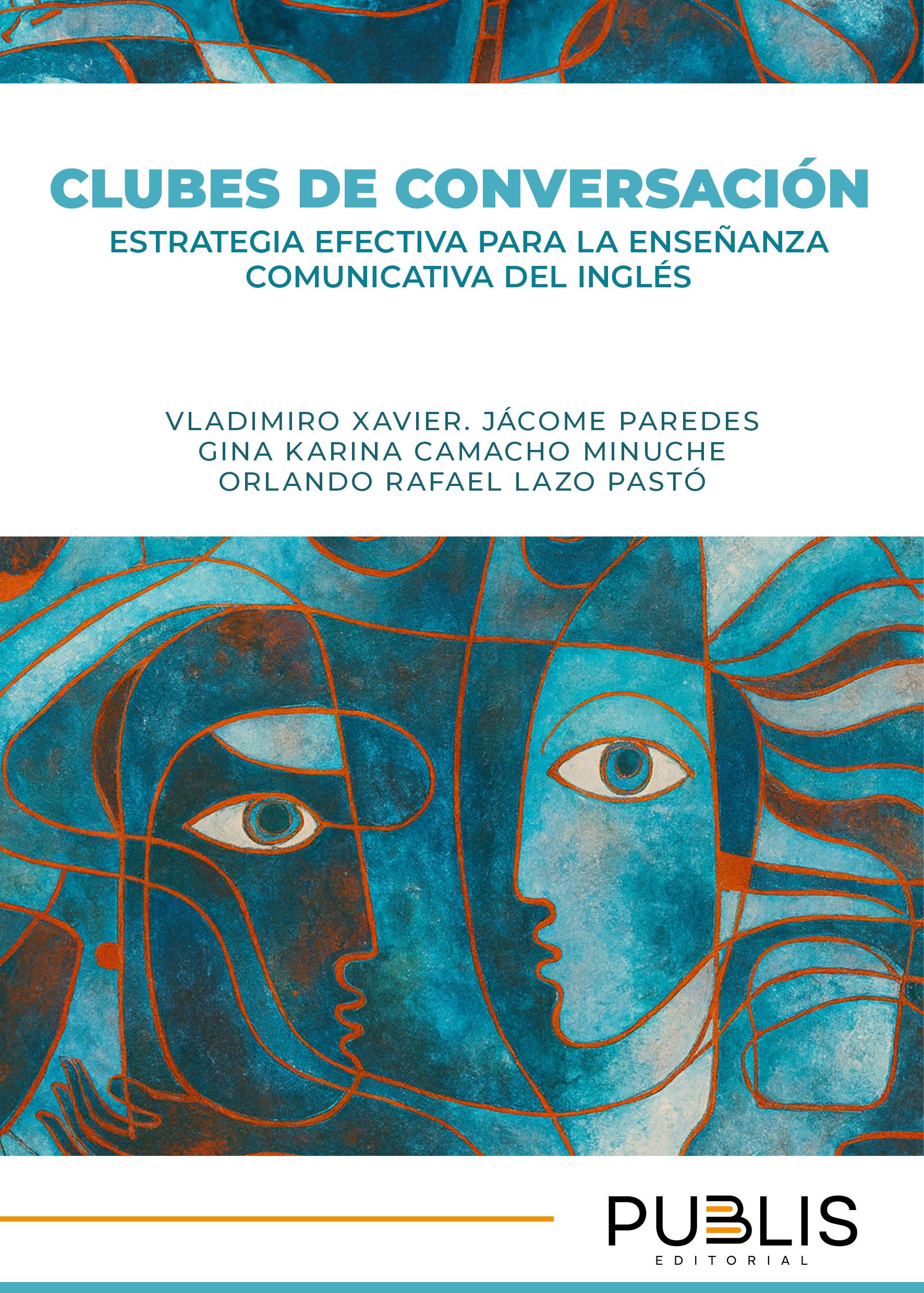
Clubes de conversación: estrategia efectiva para la enseñanza comunicativa del inglés
Palabras clave:
Clubes de conversación, Enseñanza comunicativa, Inglés como lengua extranjera, Fluidez oral, Motivación del aprendizajeSinopsis
Clubes de conversación: estrategia efectiva para la enseñanza comunicativa del inglés es una obra académica que analiza y fundamenta el uso de los clubes de conversación como una estrategia pedagógica clave en la enseñanza del inglés como lengua extranjera. El libro integra bases teóricas del enfoque comunicativo con evidencias empíricas y propuestas metodológicas prácticas, destacando el impacto de estos espacios en el desarrollo de la fluidez oral, la pronunciación, la motivación y la confianza de los estudiantes. Dirigido a docentes e instituciones educativas, ofrece orientaciones claras para implementar clubes de conversación en contextos formales, no formales y virtuales, promoviendo una enseñanza más interactiva, inclusiva y centrada en el estudiante.
Descargas
Referencias
Affeldt, F., Meinhart, D., & Eilks, I. (2018). The Use of Comics in Experimental Instructions in a Non-formal Chemistry Learning Context. International Journal of Education in Mathematics, Science and Technology, 6(1), 93-104. https://doi.org/10.18404/ijemst.380620
Alcazar, M. I., Triana, M. L., Carpio, M. M., & Garcia, V. A. (2021). Speaking-club on-line para fortalecer la expresión oral del idioma inglés en estudiantes de secundaria. South Florida Journal of Development, 2(5), 8309-8332. https://doi.org/10.46932/sfjdv2n5-143
Allaste, A.-A., Beilmann, M., & Pirk, R. (2021). Non-formal and Informal Learning as Citizenship Education: The Views of Young People and Youth Policymakers. Journal of Applied Youth Studies, 5, 19-35. https://doi.org/10.1007/s43151-021-00059-z
Alnajjar, E. A. M. (2021). The Impact of a Proposed Science Informal Curriculum on Students’ Achievement and Attitudes During the Covid-19. International Journal of Early Childhood Special Education (INT-JECSE), 13(2), 882–896. https://doi.org/10.9756/INT-JECSE/V13I2.211131
Alvermann, D. E., Young, J. P., Green, C., & Wisenbaker, J. M. (1999). Adolescents’ Perceptions and Negotiations of Literacy Practices in After-School Read and Talk Clubs. American Educational Research Journal, 36(2), 221-264. https://doi.org/10.3102/00028312036002221
Asefa, D. T., & Enashe, M. B. (2024). Teachers’ Role in Enhancing the Students’ Speaking Skills. Language and Text, 11(1), 131-142. http://dx.doi.org/10.17759/langt.2024110112
Aycicek, B. (2021). Metaphorical Perceptions of High School Teachers Regarding the Hidden Curriculum. Shanlax International Journal of Education, 9(4), 280–293. https://doi.org/10.34293/education.v9i4.4158
Badger, J. (2021). Learning in non-formal settings: Investigating cemetery guides’ talk during school visits. International Journal of Educational Research, 109, 101852. https://doi.org/10.1016/j.ijer.2021.101852
Bamkin, S. (2020). The taught curriculum of moral education at Japanese elementary school: The role of classtime in the broad curriculum. Contemporary Japan, 32(2), 218–239. https://doi.org/10.1080/18692729.2020.1747780
Bjorklund, D. (1985). Dignified joking: humor and demeanor i a public speaking club. Symbolic Interaction, 8(1), 33-46 https://doi.org/10.1525/si.1985.8.1.33
Bjørnåvold, J. (2000). Making Learning Visible: Identification, Assessment and Recognition of Non-Formal Learning in Europe. Cedefop - European Centre for the Development of Vocational Training. https://www.cedefop.europa.eu/files/3013_en.pdf
Bourke, R., O’Neill, J., & Loveridge, J. (2018). Children’s conceptions of informal and everyday learning. Oxford Review of Education, 44(6), 771–786. https://doi.org/10.1080/03054985.2018.1450238
Cain, T., & Chapman, A. (2014). Dysfunctional dichotomies? Deflating bipolar constructions of curriculum and pedagogy through case studies from music and history. The Curriculum Journal, 25(1), 111–129. https://doi.org/10.1080/09585176.2013.877396
Coombs, P., & Ahmed, M. (1974). Attacking Rural Poverty. The John Hopkins University Press. https://documents.worldbank.org/en/publication/documents-reports/documentdetail/656871468326130937/attacking-rural-poverty-how-nonformal-education-can-help
Demydovych, O. & Holik, O. (2020). Speaking club as an interactive extracurricular activity in learning English for professional purposes at medical universities. Advanced Education, 14, 4-10. https://doi.org/10.20535/2410-8286.178238
Dovey, K., & Fisher, K. (2014). Designing for adaptation: the school as socio-spatial assemblage, The Journal of Architecture, 19(1), 43-63, http://dx.doi.org/10.1080/13602365.2014.882376
Evans, S. E., Beauchamp, G., & John, V. (2015). Learners’ experience and perceptions of informal learning in Key Stage 3 music: A collective case study, exploring the implementation of Musical Futures in three secondary schools in Wales. Music Education Research, 17(1), 1-16. https://doi.org/10.1080/14613808.2014.950212
Frappart, S., & Frède, V. (2016). Conceptual change about outer space: How does informal training combined with formal teaching affect seventh graders’ understanding of gravitation? European Journal of Psychology of Education, 31(4), 515–535. https://doi.org/10.1007/s10212-015-0275-4
Gage, N., Low, B., & Reyes, F. L. (2020). Listen to the tastemakers: Building an urban arts high school music curriculum. Research Studies in Music Education, 42(1), 19–36. https://doi.org/10.1177/1321103X19837758
Garner, N., Siol, A., & Eilks, I. (2015). The Potential of Non-Formal Laboratory Environments for Innovating the Chemistry Curriculum and Promoting Secondary School Level Students Education for Sustainability. Sustainability, 7(2), 2. https://doi.org/10.3390/su7021798
Gee, K. A. (2015). Achieving gender equality in learning outcomes: Evidence from a nonformal education program in Bangladesh. International Journal of Educational Development, 40, 207–216. https://doi.org/10.1016/j.ijedudev.2014.09.001
Govea, L. (2007). El club conversacional: una estrategia interaccional de aprendizaje para estudiantes de inglés como lengua extranjera. Educare, 11(Extraordinario). https://revistas.investigacion-upelipb.com/index.php/educare/article/view/387/371
Hidayat, S., Ruhiat, Y., & Syafrizal. (2016). Mentoring and Curriculum Development Model to Improve Quality of nonformal Education (NFE) in Banten Province. Proceeding, 3rd NFE Conference on Lifelong Learning, 246-248. https://doi.org/10.2991/nfe-16.2017.64
Ionescu, F. (2020). Non-formal education approaches in school organization methodological aspects and case study. Journal of Education, Society & Multiculturalism, 1(2), 1-16. https://www.jesm.ro/wp-content/uploads/2020/12/pp.-1-16-Non-formal-education-approaches-in-school-organization.-Florentina-Ciulei-1.pdf
Ivanova, I. V. (2016). Non-formal Education: Investing in Human Capital. Russian Education & Society, 58(11), 718-731. https://doi.org/10.1080/10609393.2017.1342195
Johnson, M., & Majewska, D. (2022). Formal, non-formal, and informal learning: What are they, and how can we research them? Cambridge University Press & Assessment Research Report.
Johnson, M., & Oates, T. (2016). Making Sense of a Learning Space: How Freestyle Scooter-riders Learn in a Skate Park. Informal Learning Review, 140, 17–21. https://www.cambridgeassessment.org.uk/Images/403028-making-sense-of-a-learning-space-how-freestyle-scooter-riders-learn-in-a-skatepark.pdf
Jung, H., & Choi, E. (2016). The importance of indirect teaching behaviour and its educational effects in physical education. Physical Education and Sport Pedagogy, 21(2), 121–136. https://doi.org/10.1080/17408989.2014.923990
Kamal, Z. (2019). Teacher’s Role and the Principles of Teaching Speaking Skill. Tafhim Al-’Ilmi, 10(2), 140–156. https://doi.org/10.37459/tafhim.v10i2.3430
Kidman, J., Yen, C.-F., & Abrams, E. (2013). Indigenous Students’ Experiences of the Hidden Curriculum in Science Education: A Cross-National Study in New Zealand and Taiwan. International Journal of Science and Mathematics Education, 11(1), 4364. https://doi.org/10.1007/s10763-012-9365-9
Kiilakoski, T., & Kivijärvi, A. (2015). Youth clubs as spaces of non-formal learning: Professional idealism meets the spatiality experienced by young people in Finland. Studies in Continuing Education, 37(1), 47–61. https://doi.org/10.1080/0158037X.2014.967345
Kovaleva, E. (2014). Разговорный клуб на английском языке по экономике как эффективный способ формирования и развития коммуникативной компетенции студентов неязыковых экономических вузов. Достижения Вузовской Науки, (11), 70-73 [Club de conversación en inglés sobre economía como forma efectiva de formar y desarrollar la competencia comunicativa de los estudiantes de universidades económicas no lingüísticas. Logros de la ciencia universitaria, (11), 70-73]. https://www.elibrary.ru/item.asp?id=21875725
Kral, I., & Heath, S. B. (2013). The world with us: Sight and sound in the “cultural flows” of informal learning. An Indigenous Australian case. Learning, Culture and Social Interaction, 2(4), 227–237. https://doi.org/10.1016/j.lcsi.2013.07.002
Läänemets, U., Kalamees-Ruubel, K., Kiilu, K., & Sepp, A. (2018). Curriculum Development Considering Formal, Non-Formal and Informal Education. Society. Integration. Education. Proceedings of the International Scientific Conference, 2, 286-295. https://doi.org/10.17770/sie2018vol1.3182
Latchem, C. (2018). Open and Distance Non-formal Education. In C. Latchem (Ed.), Open and Distance Non-formal Education in Developing Countries. Springer. https://doi.org/10.1007/978-981-10-6741-9_2
LePendu, P., Cheung, C., Salloum, M., Sheffler, P., & Downey, K. (2021). Summer Coding Camp: Curriculum, Experiences, and Evaluation. 2021 ASEE Virtual Annual Conference Content Access. https://peer.asee.org/summer-coding-camp-curriculumexperiences-and-evaluation
Lin, P.-Y., & Schunn, C. D. (2016). The dimensions and impact of informal science learning experiences on middle schoolers’ attitudes and abilities in science. International Journal of Science Education, 38(17), 2551–2572. https://doi.org/10.1080/09500693.2016.1251631
Madjar, N., & Cohen-Malayev, M. (2013). Youth movements as educational settings promoting personal development: Comparing motivation and identity formation in formal and non-formal education contexts. International Journal of Educational Research, 62, 162-174. https://doi.org/10.1016/j.ijer.2013.09.002
McKay, M. M., Lowes, S., Tirthali, D., McGrath, E. W., Sayres, J., & Peterson, K. A. D. (2013). Transforming a Middle and High School Robotics Curriculum. Annual Conference & Exposition, Atlanta, Georgia. https://peer.asee.org/transforming-a-middle-and-high-school-roboticscurriculum
McPhail, G. (2013). Informal and formal knowledge: The curriculum conception of two rock graduates. British Journal of Music Education, 30(1), 43–57. https://doi.org/10.1017/S0265051712000228
Melnic, A.-S., & Botez, N. (2014). Formal, Non-Formal and Informal Interdependence in Education. Economy Transdisciplinarity Cognition, 17(1), 113–118. https://www.ugb.ro/etc/etc2014no1/18_Melnic__Botez.pdf
Moldovan, O., & Bocoş-Binţinţan, V. (2015). The Necessity of Reconsidering the Concept of Non-formal Education. Procedia - Social and Behavioral Sciences, 209, 337-343. https://doi.org/10.1016/j.sbspro.2015.11.245
Morris, T. H. (2019). Self-directed learning: A fundamental competence in a rapidly changing world. International Review of Education, 65(4), 633–653. https://doi.org/10.1007/s11159-019-09793-2
Ordoñez, J., & Villafuerte, J. (2021). Strengthening university students’ listening and speaking skills in English as a foreign language: online international conversation clubs. European Journal of Foreign Language Teaching, 5. http://dx.doi.org/10.46827/ejfl.v5i4.3780
Pienimäki, M., Kinnula, M., & Iivari, N. (2021). Finding fun in non-formal technology education. International Journal of Child-Computer Interaction, 29, 100283. https://doi.org/10.1016/j.ijcci.2021.100283
Powdyel, T. S. (2016). Non-Formal Education in Bhutan: Origin, Evolution, and Impact. In M. J. Schuelka & T.W. Maxwell (Eds.), Education in Bhutan: Culture, Schooling, and Gross National Happiness (pp. 169–180). Springer. https://doi.org/10.1007/978-98110-1649-3_11
Powdyel, T. S. (2016). Non-Formal Education in Bhutan: Origin, Evolution, and Impact. In M. J. Schuelka & T.W. Maxwell (Eds.), Education in Bhutan: Culture, Schooling, and Gross National Happiness (pp. 169–180). Springer. https://doi.org/10.1007/978-98110-1649-3_11
Radović, S., & Passey, D. (2016). Digital resource developments for mathematics education involving homework across formal, non-formal and informal settings. The Curriculum Journal, 27(4), 538-559. https://doi.org/10.1080/09585176.2016.1158726
Rahman, K. (2013). Belonging and learning to belong in school: The implications of the hidden curriculum for indigenous students. Discourse: Studies in the Cultural Politics of Education, 34(5), 660–672. https://doi.org/10.1080/01596306.2013.728362
Rannala, I.-E., & Dibou, T. (2020). Non-formal learning in youth work: Questions and examples inspired from Estonian youth work. Youth Voice Journal. https://www.rj4allpublications.com/wp-content/uploads/2020/05/T.-Dibou.pdf
Sikder, S. (2016). Role of a Teacher in Teaching Speaking by Following a Communicative Approach: To What Extent is this Possible in an ESL Context like Bangladesh? Global Journal of Human-Social Science, XVI(3), 51-54. https://gjhss.com/index.php/gjhss/article/download/3549/3549/7098
Simac, J., Marcus, R., & Harper, C. (2021). Does non-formal education have lasting effects? Compare: A Journal of Comparative and International Education, 51(5), 706–724. https://doi.org/10.1080/03057925.2019.1669011
Souto-Otero, M. (2021). Validation of non-formal and informal learning in formal education: Covert and overt. European Journal of Education, 56(3), 365–379. https://doi.org/10.1111/ejed.12464
Srakaew, P. N. (2021). The Importance of Pronunciation in English Communication. Journal of Asian Language Teaching and Learning (Online), 2(2), 11-18. https://so10.tci-thaijo.org/index.php/jote/article/view/491
Suban, T. S. (2021). Teaching speaking: activities to promote speaking skills in efl classrooms. Lectio: Journal of Language and Language Teaching, 1(1), 41-50. https://gjhss.com/index.php/gjhss/article/download/3549/3549/7098
Tang, X., & Zhang, D. (2020). How informal science learning experience influences students’ science performance: A cross-cultural study based on PISA 2015. International Journal of Science Education, 42(4), 598–616. https://doi.org/10.1080/09500693.2020.1719290
Valderrama, N. A. (2021). El club de conversación como propuesta pedagógica para mejorar el nivel de desempeño en las habilidades lingüísticas de los estudiantes en el área de idioma extranjero inglés. Universidad Nacional Abierta y a Distancia UNAD. https://repository.unad.edu.co/jspui/bitstream/10596/41109/1/navalderramas.pdf?utm
Wiebe, E. N., Faber, M., Corn, J., Collins, T.L., Unfried, A., & Townsend, L. (2013). A Large-scale Survey of K-12 Students about STEM: Implications for Engineering Curriculum Development and Outreach Efforts (Research to Practice). 2013 ASEE Annual Conference & Exposition, Atlanta, GE. https://peer.asee.org/a-large-scalesurvey-of-k-12-students-about-stem-implications-for-engineering-curriculumdevelopment-and-outreach-efforts-research-to-practice
Yeasmin, N., Uusiautti, S., & Määttä, K. (2020). Is non-formal learning a solution to enhance immigrant children’s empowerment in northern Finnish communities? Migration and Development, 1-19. https://doi.org/10.1080/21632324.2020.1742993
Zounhin, C. M. (2021). English Language Learning Clubs: A Novel Approach to Improving EFL Students’ Verbal Communication Skills. International Journal on Studies in English Language and Literature, 9(7). https://doi.org/10.20431/2347-3134.0907001
Descargas
Publicado
Colección
Licencia

Esta obra está bajo una licencia internacional Creative Commons Atribución-NoComercial-CompartirIgual 4.0.