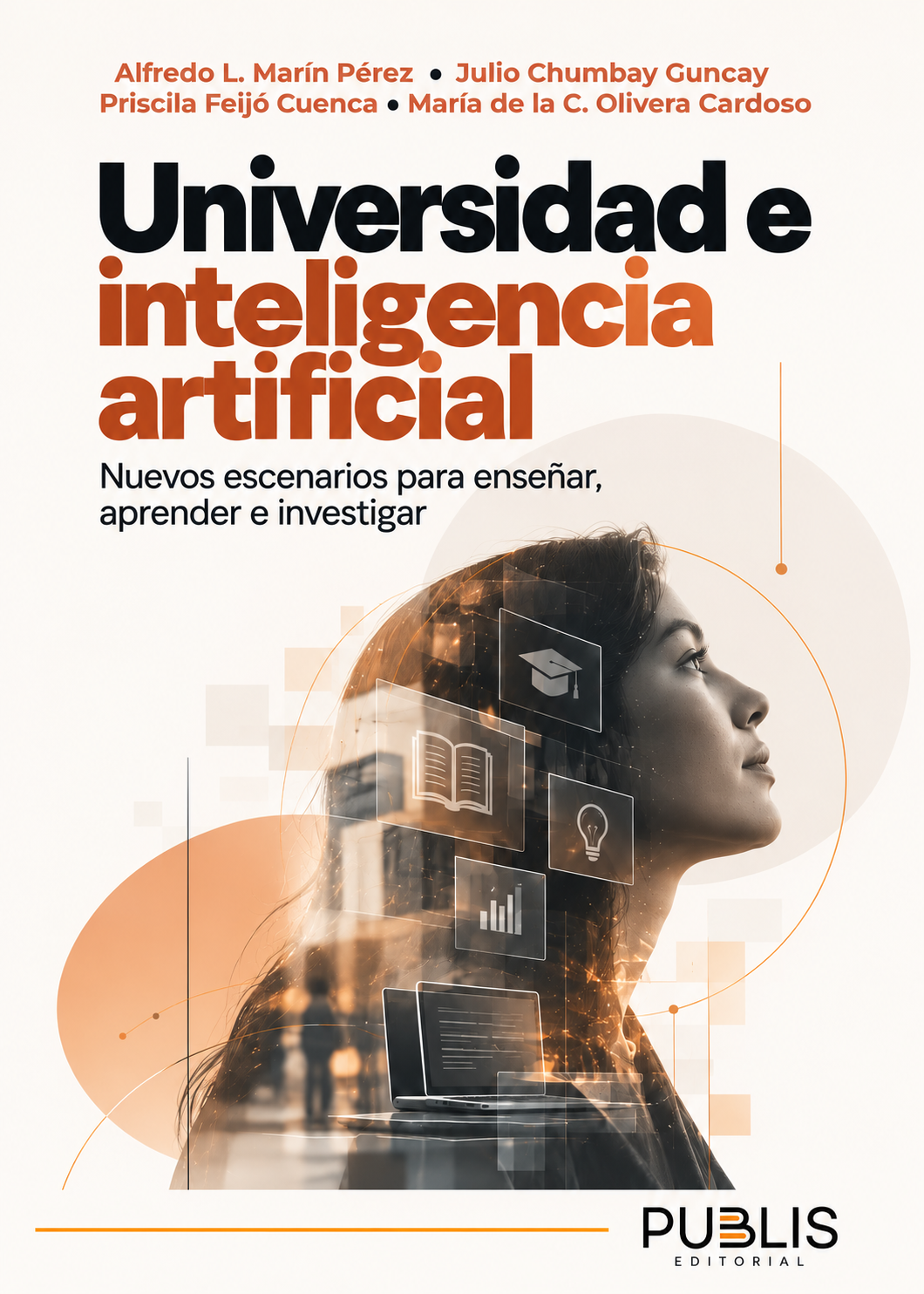
Universidad e inteligencia artificial: nuevos escenarios para enseñar, aprender e investigar
Keywords:
Inteligencia artificial, Educación superior, Inteligencia artificial generativa, Docencia universita, Investigación científica, Ética de la inteligencia artificial, Gobernanza universitariaSynopsis
La incorporación de la inteligencia artificial en la educación superior está transformando las prácticas de enseñanza, los procesos de aprendizaje, la investigación científica y los mecanismos de gestión institucional. Este libro examina las oportunidades, desafíos e implicaciones de estas transformaciones desde una perspectiva académica que integra dimensiones pedagógicas, tecnológicas, éticas y organizacionales.
La obra aborda la evolución de la inteligencia artificial en el ámbito universitario, sus aplicaciones en la planificación docente, la creación de recursos educativos, la evaluación del aprendizaje y el acompañamiento estudiantil. Asimismo, analiza el desarrollo de competencias digitales, la alfabetización en inteligencia artificial, la autonomía intelectual y el pensamiento crítico frente al uso creciente de herramientas generativas.
En el campo de la investigación científica, se examinan las posibilidades de estas tecnologías para apoyar la búsqueda bibliográfica, el análisis de datos, la escritura académica y la comunicación de resultados, considerando sus limitaciones y las exigencias de integridad, transparencia y responsabilidad científica.
El análisis incorpora los desafíos relacionados con la privacidad, los sesgos algorítmicos, la equidad, la inclusión y la gobernanza universitaria, con atención a las condiciones particulares de las instituciones de educación superior latinoamericanas. Desde esta perspectiva, la integración de la inteligencia artificial se comprende como un proceso que requiere criterios pedagógicos, evaluación de evidencias y políticas institucionales capaces de preservar la autonomía humana y la calidad académica.
Dirigido a docentes, investigadores, estudiantes universitarios y responsables de la gestión educativa, el libro contribuye a la reflexión sobre una incorporación crítica, ética y contextualizada de la inteligencia artificial en las funciones sustantivas de la universidad.
Downloads
References
Albadarin, Y., Saqr, M., Pope, N., & Tukiainen, M. (2024). A systematic literature review of empirical research on ChatGPT in education. Discover Education, 3, 60. https://doi.org/10.1007/s44217-024-00138-2
Almatrafi, O., Johri, A., & Lee, H. (2024). A systematic review of AI literacy conceptualization, constructs, and implementation and assessment efforts (2019–2023). Computers and Education Open, 6, 100173. https://doi.org/10.1016/j.caeo.2024.100173
Alotaibi, A. E., Aseery, A., Alfayez, A. A., Bashatah, L., & Aseri, S. (2026). Governance of generative AI in higher education: A qualitative analysis of universities’ policies and global insights. British Educational Research Journal. https://doi.org/10.1002/berj.70256
Altmäe, S., Sola-Leyva, A., & Salumets, A. (2023). Artificial intelligence in scientific writing: A friend or a foe? Reproductive BioMedicine Online, 47(1), 3–9. https://doi.org/10.1016/j.rbmo.2023.04.009
Alubthane, F. O. (2026). Amplifier or substitute? A systematic review of generative AI’s impact on higher-order cognitive skills among university students. Frontiers in Psychology, 17, Article 1863931. https://doi.org/10.3389/fpsyg.2026.1863931
An, Q., Koh, J. H. L., & Liu, Q. (2026). Generative artificial intelligence in higher education: A systematic review of student use and learning outcomes. Australasian Journal of Educational Technology, 42(3), 62–82. https://doi.org/10.14742/ajet.10561
Ba, S., Yang, L., Yan, Z., Looi, C. K., & Gašević, D. (2025). Unraveling the mechanisms and effectiveness of AI-assisted feedback in education: A systematic literature review. Computers and Education Open, 9, Article 100284. https://doi.org/10.1016/j.caeo.2025.100284
Baidoo-Anu, D., Asamoah, D., Amoako, I., & Mahama, I. (2024). Exploring student perspectives on generative artificial intelligence in higher education learning. Discover Education, 3, 98. https://doi.org/10.1007/s44217-024-00173-z
Baig, M. I., & Yadegaridehkordi, E. (2024). ChatGPT in higher education: A systematic literature review and research challenges. International Journal of Educational Research, 127, 102411. https://doi.org/10.1016/j.ijer.2024.102411
Bender, E. M., Gebru, T., McMillan-Major, A., & Shmitchell, S. (2021). On the dangers of stochastic parrots: Can language models be too big? In Proceedings of the 2021 ACM Conference on Fairness, Accountability, and Transparency (pp. 610–623). Association for Computing Machinery. https://doi.org/10.1145/3442188.3445922
Bhullar, P. S., Joshi, M., & Chugh, R. (2024). ChatGPT in higher education – a synthesis of the literature and a future research agenda. Education and Information Technologies, 29, 21501–21522. https://doi.org/10.1007/s10639-024-12723-x
Bjelobaba, S., Waddington, L., Perkins, M., Foltýnek, T., Bhattacharyya, S., & Weber-Wulff, D. (2025). Maintaining research integrity in the age of GenAI: An analysis of ethical challenges and recommendations to researchers. International Journal for Educational Integrity, 21, 18. https://doi.org/10.1007/s40979-025-00191-w
Bommasani, R., Hudson, D. A., Adeli, E., Altman, R., Arora, S., von Arx, S., Bernstein, M. S., Bohg, J., Bosselut, A., Brunskill, E., Brynjolfsson, E., Buch, S., Card, D., Castellon, R., Chatterji, N., Chen, A., Creel, K., Davis, J. Q., Demszky, D., ... Liang, P. (2021). On the opportunities and risks of foundation models [Preprint]. arXiv. https://doi.org/10.48550/arXiv.2108.07258
Bond, M., Khosravi, H., De Laat, M., Bergdahl, N., Negrea, V., Oxley, E., Pham, P., Chong, S. W., & Siemens, G. (2024). A meta systematic review of artificial intelligence in higher education: A call for increased ethics, collaboration, and rigour. International Journal of Educational Technology in Higher Education, 21, 4. https://doi.org/10.1186/s41239-023-00436-z
Bridge, C., Naylor, R., & Loch, B. (2024). “All things are ready, if our mind be so”: Attitudes to STEM assessment redesign in the age of genAI. In T. Cochrane, V. Narayan, E. Bone, C. Deneen, M. Saligari, K. Tregloan, & R. Vanderburg (Eds.), Navigating the terrain: Emerging frontiers in learning spaces, pedagogies, and technologies. Proceedings ASCILITE 2024 (pp. 234–243). https://doi.org/10.14742/apubs.2024.1426
Carolus, A., Koch, M. J., Straka, S., Latoschik, M. E., & Wienrich, C. (2023). MAILS – Meta AI literacy scale: Development and testing of an AI literacy questionnaire based on well-founded competency models and psychological change- and meta-competencies. Computers in Human Behavior: Artificial Humans, 1(2), 100014. https://doi.org/10.1016/j.chbah.2023.100014
Chan, C. K. Y. (2023). A comprehensive AI policy education framework for university teaching and learning. International Journal of Educational Technology in Higher Education, 20, 38. https://doi.org/10.1186/s41239-023-00408-3
Chan, C. K. Y., & Hu, W. (2023). Students’ voices on generative AI: Perceptions, benefits, and challenges in higher education. International Journal of Educational Technology in Higher Education, 20, 43. https://doi.org/10.1186/s41239-023-00411-8
Chiu, T. K. F. (2024). Future research recommendations for transforming higher education with generative AI. Computers and Education: Artificial Intelligence, 6, 100197. https://doi.org/10.1016/j.caeai.2023.100197
Chiu, T. K. F., Xia, Q., Zhou, X., Chai, C. S., & Cheng, M. (2023). Systematic literature review on opportunities, challenges, and future research recommendations of artificial intelligence in education. Computers and Education: Artificial Intelligence, 4, 100118. https://doi.org/10.1016/j.caeai.2022.100118
Cotton, D. R. E., Cotton, P. A., & Shipway, J. R. (2024). Chatting and cheating: Ensuring academic integrity in the era of ChatGPT. Innovations in Education and Teaching International, 61(2), 228–239. https://doi.org/10.1080/14703297.2023.2190148
Crompton, H., & Burke, D. (2023). Artificial intelligence in higher education: The state of the field. International Journal of Educational Technology in Higher Education, 20, 22. https://doi.org/10.1186/s41239-023-00392-8
Dalalah, D., & Dalalah, O. M. A. (2023). The false positives and false negatives of generative AI detection tools in education and academic research: The case of ChatGPT. The International Journal of Management Education, 21(2), 100822. https://doi.org/10.1016/j.ijme.2023.100822
Del Río, C. S., Monge-Rogel, R., Fuentes-Lama, R., & Fernández-Ochoa, H. (2026). Cultural adaptation and validation of a ChatGPT literacy scale for university students in Chile. Current Psychology, 45, Article 778. https://doi.org/10.1007/s12144-026-09314-z
Deng, R., Jiang, M., Yu, X., Lu, Y., & Liu, S. (2025). Does ChatGPT enhance student learning? A systematic review and meta-analysis of experimental studies. Computers & Education, 227, 105224. https://doi.org/10.1016/j.compedu.2024.105224
Dwivedi, Y. K., Kshetri, N., Hughes, L., Slade, E. L., Jeyaraj, A., Kar, A. K., Baabdullah, A. M., Koohang, A., Raghavan, V., Ahuja, M., Albanna, H., Albashrawi, M. A., Al-Busaidi, A. S., Balakrishnan, J., Barlette, Y., Basu, S., Bose, I., Brooks, L., Buhalis, D., ... Wright, R. (2023). “So what if ChatGPT wrote it?” Multidisciplinary perspectives on opportunities, challenges and implications of generative conversational AI for research, practice and policy. International Journal of Information Management, 71, 102642. https://doi.org/10.1016/j.ijinfomgt.2023.102642
Elkhatat, A. M., Elsaid, K., & Almeer, S. (2023). Evaluating the efficacy of AI content detection tools in differentiating between human and AI-generated text. International Journal for Educational Integrity, 19, 17. https://doi.org/10.1007/s40979-023-00140-5
Farrokhnia, M., Banihashem, S. K., Noroozi, O., & Wals, A. (2024). A SWOT analysis of ChatGPT: Implications for educational practice and research. Innovations in Education and Teaching International, 61(3), 460–474. https://doi.org/10.1080/14703297.2023.2195846
Flanagin, A., Bibbins-Domingo, K., Berkwits, M., & Christiansen, S. L. (2023). Nonhuman “authors” and implications for the integrity of scientific publication and medical knowledge. JAMA, 329(8), 637–639. https://doi.org/10.1001/jama.2023.1344
Floridi, L., & Cowls, J. (2019). A unified framework of five principles for AI in society. Harvard Data Science Review, 1(1). https://doi.org/10.1162/99608f92.8cd550d1
Gallegos, I. O., Rossi, R. A., Barrow, J., Tanjim, M. M., Kim, S., Dernoncourt, F., Yu, T., Zhang, R., & Ahmed, N. K. (2024). Bias and fairness in large language models: A survey. Computational Linguistics, 50(3), 1097–1179. https://doi.org/10.1162/coli_a_00524
Ghimire, A., & Edwards, J. (2024). From guidelines to governance: A study of AI policies in education [Preprint]. arXiv. https://doi.org/10.48550/arXiv.2403.15601
Gomes, M. G. S., Ramos, A. S. M., & de Oliveira, K. (2025). Guidelines and frameworks of governance for the adoption of generative artificial intelligence in higher education institutions: A scoping review. Revista de Administração da UFSM, 18(4), e1. https://doi.org/10.5902/1983465990871
Goodfellow, I., Bengio, Y., & Courville, A. (2016). Deep learning. MIT Press. https://www.deeplearningbook.org/
Holmes, W., Porayska-Pomsta, K., Holstein, K., Sutherland, E., Baker, T., Buckingham Shum, S., Santos, O. C., Rodrigo, M. T., Cukurova, M., Bittencourt, I. I., & Koedinger, K. R. (2022). Ethics of AI in education: Towards a community-wide framework. International Journal of Artificial Intelligence in Education, 32(3), 504–526. https://doi.org/10.1007/s40593-021-00239-1
Hornberger, M., Bewersdorff, A., & Nerdel, C. (2023). What do university students know about artificial intelligence? Development and validation of an AI literacy test. Computers and Education: Artificial Intelligence, 5, 100165. https://doi.org/10.1016/j.caeai.2023.100165
Hosseini, M., Rasmussen, L. M., & Resnik, D. B. (2024). Using AI to write scholarly publications. Accountability in Research, 31(7), 715–723. https://doi.org/10.1080/08989621.2023.2168535
Huang, J., & Tan, M. (2023). The role of ChatGPT in scientific communication: Writing better scientific review articles. American Journal of Cancer Research, 13(4), 1148–1154. https://pmc.ncbi.nlm.nih.gov/articles/PMC10164801/
Jaffar, M., Jogezai, N. A., Abdul Latiff, A. R., Baloch, F. A., & Khilji, G. K. (2024). University teachers at the crossroads: Unpacking their intentions toward ChatGPT’s instructional use. Journal of Applied Research in Higher Education, 17(4), 1330–1342. https://doi.org/10.1108/JARHE-10-2023-0463
Jin, Y., Yan, L., Echeverria, V., Gašević, D., & Martinez-Maldonado, R. (2025). Generative AI in higher education: A global perspective of institutional adoption policies and guidelines. Computers and Education: Artificial Intelligence, 8, 100348. https://doi.org/10.1016/j.caeai.2024.100348
Jobin, A., Ienca, M., & Vayena, E. (2019). The global landscape of AI ethics guidelines. Nature Machine Intelligence, 1, 389–399. https://doi.org/10.1038/s42256-019-0088-2
Kasneci, E., Seßler, K., Küchemann, S., Bannert, M., Dementieva, D., Fischer, F., Gasser, U., Groh, G., Günnemann, S., Hüllermeier, E., Krusche, S., Kutyniok, G., Michaeli, T., Nerdel, C., Pfeffer, J., Poquet, O., Sailer, M., Schmidt, A., Seidel, T., ... Kasneci, G. (2023). ChatGPT for good? On opportunities and challenges of large language models for education. Learning and Individual Differences, 103, 102274. https://doi.org/10.1016/j.lindif.2023.102274
Kassorla, M., Georgieva, M., & Papini, A. (2024). AI literacy in teaching and learning: A durable framework for higher education. EDUCAUSE. https://www.educause.edu/content/2024/ai-literacy-in-teaching-and-learning/defining-ai-literacy-for-higher-education
Khalifa, M., & Albadawy, M. (2024). Using artificial intelligence in academic writing and research: An essential productivity tool. Computer Methods and Programs in Biomedicine Update, 5, 100145. https://doi.org/10.1016/j.cmpbup.2024.100145
Kohnke, L., Moorhouse, B. L., & Zou, D. (2023). ChatGPT for language teaching and learning. RELC Journal, 54(2), 537–550. https://doi.org/10.1177/00336882231162868
Labadze, L., Grigolia, M., & Machaidze, L. (2023). Role of AI chatbots in education: Systematic literature review. International Journal of Educational Technology in Higher Education, 20, 56. https://doi.org/10.1186/s41239-023-00426-1
Laupichler, M. C., Aster, A., Schirch, J., & Raupach, T. (2022). Artificial intelligence literacy in higher and adult education: A scoping literature review. Computers and Education: Artificial Intelligence, 3, 100101. https://doi.org/10.1016/j.caeai.2022.100101
Lee, D., Arnold, M., Srivastava, A., Plastow, K., Strelan, P., Ploeckl, F., Lekkas, D., & Palmer, E. (2024). The impact of generative AI on higher education learning and teaching: A study of educators’ perspectives. Computers and Education: Artificial Intelligence, 6, 100221. https://doi.org/10.1016/j.caeai.2024.100221
Lin, Z., Guan, S., Zhang, W., Zhang, H., Li, Y., & Zhang, H. (2024). Towards trustworthy LLMs: A review on debiasing and dehallucinating in large language models. Artificial Intelligence Review, 57, 243. https://doi.org/10.1007/s10462-024-10896-y
Lintner, T. (2024). A systematic review of AI literacy scales. npj Science of Learning, 9, 50. https://doi.org/10.1038/s41539-024-00264-4
Lo, C. K. (2023). What is the impact of ChatGPT on education? A rapid review of the literature. Education Sciences, 13(4), 410. https://doi.org/10.3390/educsci13040410
Long, D., & Magerko, B. (2020). What is AI literacy? Competencies and design considerations. In Proceedings of the 2020 CHI Conference on Human Factors in Computing Systems (pp. 1–16). Association for Computing Machinery. https://doi.org/10.1145/3313831.3376727
Lund, B. D., Wang, T., Mannuru, N. R., Nie, B., Shimray, S., & Wang, Z. (2023). ChatGPT and a new academic reality: Artificial intelligence-written research papers and the ethics of the large language models in scholarly publishing. Journal of the Association for Information Science and Technology, 74(5), 570–581. https://doi.org/10.1002/asi.24750
Lye, C. Y., & Lim, L. (2024). Generative artificial intelligence in tertiary education: Assessment redesign principles and considerations. Education Sciences, 14(6), 569. https://doi.org/10.3390/educsci14060569
McGrath, C., Farazouli, A., & Cerratto-Pargman, T. (2025). Generative AI chatbots in higher education: A review of an emerging research area. Higher Education, 89, 1533–1549. https://doi.org/10.1007/s10734-024-01288-w
Mehrabi, N., Morstatter, F., Saxena, N., Lerman, K., & Galstyan, A. (2021). A survey on bias and fairness in machine learning. ACM Computing Surveys, 54(6), Article 115. https://doi.org/10.1145/3457607
Miao, F., & Cukurova, M. (2024). AI competency framework for teachers. UNESCO. https://doi.org/10.54675/ZJTE2084
Miao, F., & Holmes, W. (2023). Guidance for generative AI in education and research. UNESCO. https://doi.org/10.54675/EWZM9535
Miao, F., Shiohira, K., & Lao, N. (2024). AI competency framework for students. UNESCO. https://doi.org/10.54675/JKJB9835
Moorhouse, B. L., & Kohnke, L. (2024). The effects of generative AI on initial language teacher education: The perceptions of teacher educators. System, 122, 103290. https://doi.org/10.1016/j.system.2024.103290
Ng, D. T. K., Leung, J. K. L., Chu, K. W. S., & Qiao, M. S. (2021). AI literacy: Definition, teaching, evaluation and ethical issues. Proceedings of the Association for Information Science and Technology, 58(1), 504–509. https://doi.org/10.1002/pra2.487
OECD. (2023). OECD digital education outlook 2023: Towards an effective digital education ecosystem. OECD Publishing. https://doi.org/10.1787/c74f03de-en
Ouyang, F., & Jiao, P. (2021). Artificial intelligence in education: The three paradigms. Computers and Education: Artificial Intelligence, 2, 100020. https://doi.org/10.1016/j.caeai.2021.100020
Perkins, M. (2023). Academic integrity considerations of AI large language models in the post-pandemic era: ChatGPT and beyond. Journal of University Teaching & Learning Practice, 20(2). https://doi.org/10.53761/1.20.02.07
Salvagno, M., Taccone, F. S., & Gerli, A. G. (2023). Can artificial intelligence help for scientific writing? Critical Care, 27, 75. https://doi.org/10.1186/s13054-023-04380-2
Sharma, S. (2026). Educational integrity in GenAI-augmented assessment: Making judgement visible. International Journal for Educational Integrity, 22, 6. https://doi.org/10.1007/s40979-026-00216-y
Sperling, K., Stenberg, C.-J., McGrath, C., Åkerfeldt, A., Heintz, F., & Stenliden, L. (2024). In search of artificial intelligence (AI) literacy in teacher education: A scoping review. Computers and Education Open, 6, 100169. https://doi.org/10.1016/j.caeo.2024.100169
Sufi, F. (2024). Generative pre-trained transformer (GPT) in research: A systematic review on data augmentation. Information, 15(2), 99. https://doi.org/10.3390/info15020099
Suresh, H., & Guttag, J. V. (2021). A framework for understanding sources of harm throughout the machine learning life cycle. In Proceedings of the 1st ACM Conference on Equity and Access in Algorithms, Mechanisms, and Optimization (Article 17, pp. 1–9). Association for Computing Machinery. https://doi.org/10.1145/3465416.3483305
Tian, J., & Zhang, R. (2025). Learners’ AI dependence and critical thinking: The psychological mechanism of fatigue and the social buffering role of AI literacy. Acta Psychologica, 260, Article 105725. https://doi.org/10.1016/j.actpsy.2025.105725
Tlili, A., Shehata, B., Adarkwah, M. A., Bozkurt, A., Hickey, D. T., Huang, R., & Agyemang, B. (2023). What if the devil is my guardian angel: ChatGPT as a case study of using chatbots in education. Smart Learning Environments, 10, 15. https://doi.org/10.1186/s40561-023-00237-x
UNESCO. (2021a). AI and education: Guidance for policy-makers. https://doi.org/10.54675/PCSP7350
UNESCO. (2021b). Recommendation on the ethics of artificial intelligence. https://www.unesco.org/en/legal-affairs/recommendation-ethics-artificial-intelligence
Valentini, A. (2026). Adopción y gobernanza de la IA en la educación superior de América Latina y el Caribe: Resultados de una encuesta regional. Educación Superior y Sociedad, 37(2), 372–397. https://doi.org/10.54674/ess.v37i2.1278
van Dis, E. A. M., Bollen, J., Zuidema, W., van Rooij, R., & Bockting, C. L. (2023). ChatGPT: Five priorities for research. Nature, 614, 224–226. https://doi.org/10.1038/d41586-023-00288-7
Wang, H., Dang, A., Wu, Z., & Mac, S. (2024). Generative AI in higher education: Seeing ChatGPT through universities’ policies, resources, and guidelines. Computers and Education: Artificial Intelligence, 7, 100326. https://doi.org/10.1016/j.caeai.2024.100326
Wang, P., Jing, Y., & Shen, S. (2025). A systematic literature review on the application of generative artificial intelligence (GAI) in teaching within higher education: Instructional contexts, process, and strategies. The Internet and Higher Education, 65, 100996. https://doi.org/10.1016/j.iheduc.2025.100996
Weber-Wulff, D., Anohina-Naumeca, A., Bjelobaba, S., Foltýnek, T., Guerrero-Dib, J., Popoola, O., Šigut, P., & Waddington, L. (2023). Testing of detection tools for AI-generated text. International Journal for Educational Integrity, 19, 26. https://doi.org/10.1007/s40979-023-00146-z
Weidinger, L., Uesato, J., Rauh, M., Griffin, C., Huang, P.-S., Mellor, J., Glaese, A., Cheng, M., Balle, B., Kasirzadeh, A., Biles, C., Brown, S., Kenton, Z., Hawkins, W., Stepleton, T., Birhane, A., Hendricks, L. A., Rimell, L., Isaac, W., ... Gabriel, I. (2022). Taxonomy of risks posed by language models. In Proceedings of the 2022 ACM Conference on Fairness, Accountability, and Transparency (pp. 214–229). Association for Computing Machinery. https://doi.org/10.1145/3531146.3533088
Xia, Q., Weng, X., Ouyang, F., Lin, T. J., & Chiu, T. K. F. (2024). A scoping review on how generative artificial intelligence transforms assessment in higher education. International Journal of Educational Technology in Higher Education, 21, 40. https://doi.org/10.1186/s41239-024-00468-z
Yusuf, A., Pervin, N., & Román-González, M. (2024). Generative AI and the future of higher education: A threat to academic integrity or reformation? Evidence from multicultural perspectives. International Journal of Educational Technology in Higher Education, 21, 21. https://doi.org/10.1186/s41239-024-00453-6
Yusuf, A., Pervin, N., Román-González, M., & Noor, N. M. (2024). Generative AI in education and research: A systematic mapping review. Review of Education, 12(2), e3489. https://doi.org/10.1002/rev3.3489
Zawacki-Richter, O., Marín, V. I., Bond, M., & Gouverneur, F. (2019). Systematic review of research on artificial intelligence applications in higher education – where are the educators? International Journal of Educational Technology in Higher Education, 16, 39. https://doi.org/10.1186/s41239-019-0171-0
Downloads
Published
License

This work is licensed under a Creative Commons Attribution-NonCommercial-ShareAlike 4.0 International License.