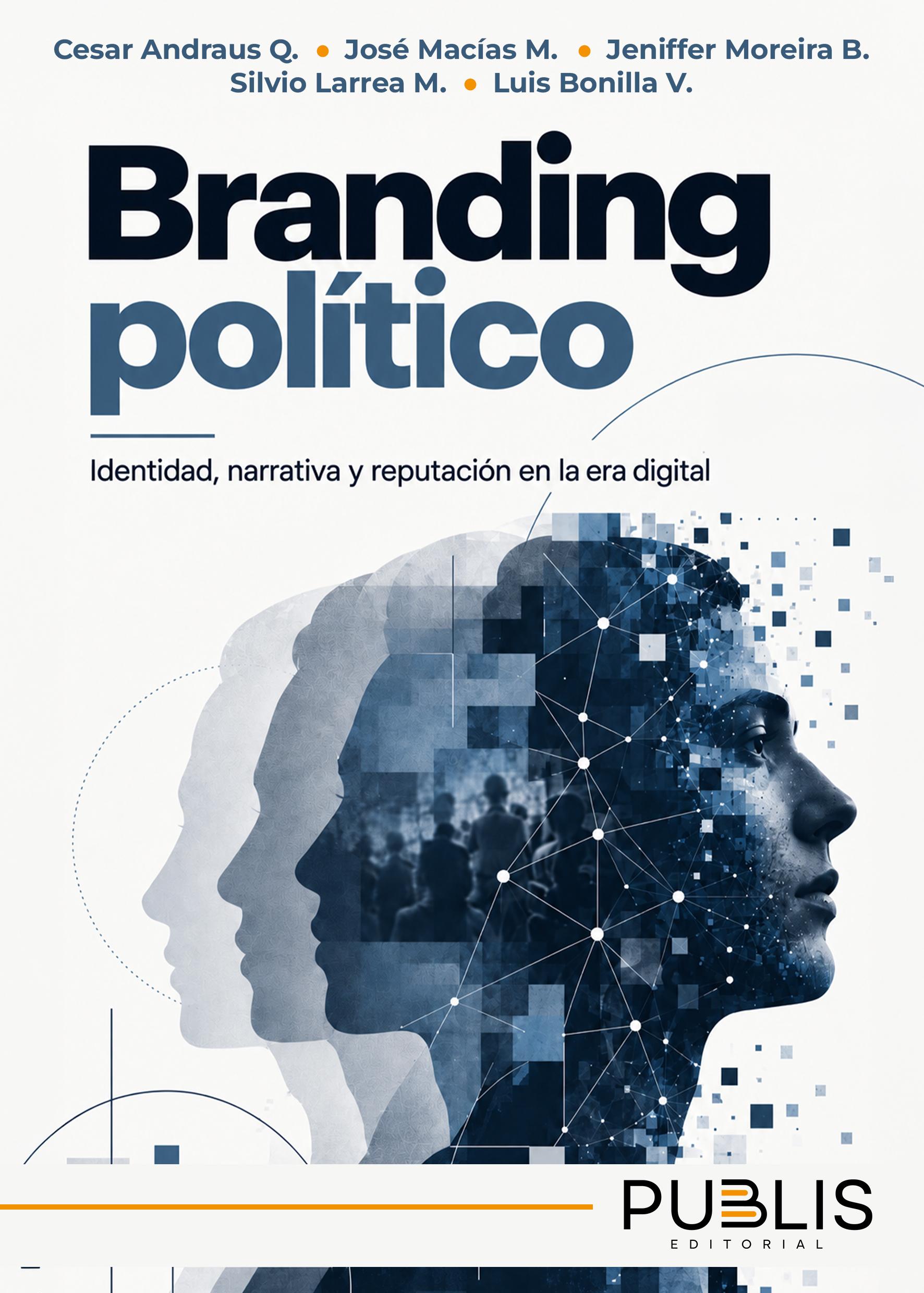
Branding político: identidad, narrativa y reputación en la era digital
Palabras clave:
Branding, Branding político, Política, Comunicación política, Comunicación digitalSinopsis
Branding político: identidad, narrativa y reputación en la era digital analiza la construcción y gestión de la marca política como un proceso estratégico y comunicacional en el que intervienen candidatos, partidos, movimientos, gobiernos, medios y ciudadanía. La obra examina conceptos como identidad, imagen, posicionamiento, narrativa, reputación, confianza y capital de marca, y estudia su transformación en un entorno marcado por las redes sociales, los contenidos audiovisuales, los algoritmos, la segmentación y la inteligencia artificial. Desde una perspectiva crítica, el libro diferencia el branding político del marketing y la comunicación política, y destaca que la marca no depende únicamente de lo que los actores desean proyectar, sino también de las interpretaciones y experiencias de los públicos. Dirigido a estudiantes, docentes, investigadores y profesionales de la comunicación y la política, ofrece una visión integral del branding político contemporáneo y de sus desafíos éticos y democráticos.
Descargas
Referencias
Ahmed, M. A., Lodhi, S. A., & Ahmad, Z. (2017). Political brand equity model: The integration of political brands in voter choice. Journal of Political Marketing, 16(2), 147–179. https://doi.org/10.1080/15377857.2015.1022629
Alhaimer, R. S. (2023). Unveiling the digital persona image: The influence of social media on political candidates’ brand personality and voter behaviour in Kuwait. Humanities and Social Sciences Communications, 10, 969. https://doi.org/10.1057/s41599-023-02420-4
Arnesson, J., & Grandien, C. (2025). Behind-the-scenes of the parliament: Influencer genres and political authenticity on Swedish politicians’ YouTube channels. Convergence: The International Journal of Research into New Media Technologies, 31(1), 385–401. https://doi.org/10.1177/13548565241260486
Au, C. H. (2025). Political brand transgression: An expanded stimuli-organism-response (SOR) framework perspective. International Review on Public and Nonprofit Marketing, 22, 517–547. https://doi.org/10.1007/s12208-025-00436-x
Avina, M. (2024). Do parties benefit from overhauling their image? The electoral consequences of ‘party rebranding’ in Europe. European Journal of Political Research, 63(2), 520–538. https://doi.org/10.1111/1475-6765.12607
Bär, D., Pierri, F., De Francisci Morales, G., & Feuerriegel, S. (2024). Systematic discrepancies in the delivery of political ads on Facebook and Instagram. PNAS Nexus, 3(7), pgae247. https://doi.org/10.1093/pnasnexus/pgae247
Banerjee, S. (2024). Political brand experience and voting intention: Is there a relation? Journal of Public Affairs, 24(1), e2889. https://doi.org/10.1002/pa.2889
Bialas, B. R. (2023). Political branding: Subterfuge or the new mode of governance? Journal of Public Governance, 64(2), 5–18. https://doi.org/10.15678/PG.2023.64.2.01
Biały, F. (2025). The first TikTok election? Social media, generative AI, and data-driven campaigning in the 2024 UK General Election. Parliamentary Affairs, 78(Supplement 1), 205–219. https://doi.org/10.1093/pa/gsaf012
Birrer, A., & Just, N. (2025). What we know and don’t know about deepfakes: An investigation into the state of the research and regulatory landscape. New Media & Society, 27(12), 6819–6838. https://doi.org/10.1177/14614448241253138
Bossetta, M. (2018). The digital architectures of social media: Comparing political campaigning on Facebook, Twitter, Instagram, and Snapchat in the 2016 U.S. election. Journalism & Mass Communication Quarterly, 95(2), 471–496. https://doi.org/10.1177/1077699018763307
Brader, T. (2005). Striking a responsive chord: How political ads motivate and persuade voters by appealing to emotions. American Journal of Political Science, 49(2), 388–405. https://doi.org/10.1111/j.0092-5853.2005.00130.x
Butler, D. M., & Powell, E. N. (2014). Understanding the party brand: Experimental evidence on the role of valence. The Journal of Politics, 76(2), 492–505. https://doi.org/10.1017/S0022381613001436
Chadwick, A. (2017). The hybrid media system: Politics and power (2nd ed.). Oxford University Press. https://doi.org/10.1093/oso/9780190696726.001.0001
Chuchu, T., Koopman, A., & Rankapole, B. (2025). Voters’ perceptions of and preferences for political party brands: Evidence from South Africa. Journal of Political Marketing. https://doi.org/10.1080/15377857.2025.2589191
Citrin, J., & Stoker, L. (2018). Political trust in a cynical age. Annual Review of Political Science, 21, 49–70. https://doi.org/10.1146/annurev-polisci-050316-092550
Cwalina, W., Falkowski, A., & Newman, B. I. (2015). Political marketing: Theoretical and strategic foundations. Taylor & Francis. https://doi.org/10.4324/9781315701684
De Fina, A. (2025). Bonding with followers: Chronotopes and scales in political communication on Instagram. Discourse Studies, 27(2), 192–213. https://doi.org/10.1177/14614456241276717
de-Lima-Santos, M.-F., Gonçalves, I., Quiles, M. G., Mesquita, L., Ceron, W., & Lorena, M. C. C. (2024). Visual political communication on Instagram: A comparative study of Brazilian presidential elections. EPJ Data Science, 13, Article 72, 1–21. https://doi.org/10.1140/epjds/s13688-024-00502-0
Duranti, A. (2006). Narrating the political self in a campaign for U.S. Congress. Language in Society, 35(4), 467–497. https://doi.org/10.1017/S0047404506060222
Enli, G. (2017). Twitter as arena for the authentic outsider: Exploring the social media campaigns of Trump and Clinton in the 2016 US presidential election. European Journal of Communication, 32(1), 50–61. https://doi.org/10.1177/0267323116682802
Enli, G. S., & Skogerbø, E. (2013). Personalized campaigns in party-centred politics: Twitter and Facebook as arenas for political communication. Information, Communication & Society, 16(5), 757–774. https://doi.org/10.1080/1369118X.2013.782330
Fordjour, N. K. O. (2023). Personalization as a strategic political tool on social media: The curious case of VP Kamala Harris on Twitter. Howard Journal of Communications, 35(4), 375–396. https://doi.org/10.1080/10646175.2023.2289980
Fordjour, N. K. O. (2024). Social media, personalization, visuals, and strategic political communication: The case of an African vice president’s image-construction on Twitter. International Journal of Strategic Communication, 18(4), 330–348. https://doi.org/10.1080/1553118X.2024.2330416
French, A., & Smith, G. (2010). Measuring political brand equity: A consumer oriented approach. European Journal of Marketing, 44(3/4), 460–477. https://doi.org/10.1108/03090561011020534
Garland, R. (2026). Executing a personal political branding campaign from within government: The case of the UK Finance Minister Rishi Sunak and social media (2020–2022). Journal of Political Marketing. https://doi.org/10.1080/15377857.2026.2613805
Grabe, M. E., & Bucy, E. P. (2009). Image bite politics: News and the visual framing of elections. Oxford University Press. https://doi.org/10.1093/acprof:oso/9780195372076.001.0001
Green, D. P., Palmquist, B., & Schickler, E. (2008). *Partisan hearts and minds: Political parties and the social identities of voters*. Yale University Press. https://doi.org/10.12987/9780300132007
Guzmán, F., & Sierra, V. (2009). A political candidate’s brand image scale: Are political candidates brands? Journal of Brand Management, 17(3), 207–217. https://doi.org/10.1057/bm.2009.19
Harff, D., & Schmuck, D. (2025). Prevalence, presentation, and popularity of political topics in social media influencers’ content across two countries. Political Communication, 42(3), 351–381. https://doi.org/10.1080/10584609.2024.2406809
Hartig, F. (2018). Political slogans as instruments of international government communication: The case of China. The Journal of International Communication, 24(1), 115–137. https://doi.org/10.1080/13216597.2018.1444664
Huddy, L., Mason, L., & Aarøe, L. (2015). Expressive partisanship: Campaign involvement, political emotion, and partisan identity. American Political Science Review, 109(1), 1–17. https://doi.org/10.1017/S0003055414000604
Iyengar, S., Sood, G., & Lelkes, Y. (2012). Affect, not ideology: A social identity perspective on polarization. Public Opinion Quarterly, 76(3), 405–431. https://doi.org/10.1093/poq/nfs038
Iyengar, S., & Westwood, S. J. (2015). Fear and loathing across party lines: New evidence on group polarization. American Journal of Political Science, 59(3), 690–707. https://doi.org/10.1111/ajps.12152
Jain, V., Goyal Gupta, D., & Sharma, H. (2025). Political branding of parties and leaders: A bibliometric clustered analysis of two decades. International Journal of Market Research, 67(2–3), 341–359. https://doi.org/10.1177/14707853251321567
Kreiss, D., Lawrence, R. G., & McGregor, S. C. (2018). In their own words: Political practitioner accounts of candidates, audiences, affordances, genres, and timing in strategic social media use. Political Communication, 35(1), 8–31. https://doi.org/10.1080/10584609.2017.1334727
Lees-Marshment, J. (2001). The marriage of politics and marketing. Political Studies, 49(4), 692–713. https://doi.org/10.1111/1467-9248.00337
Lock, A., & Harris, P. (1996). Political marketing—vive la différence! European Journal of Marketing, 30(10/11), 14–24. https://doi.org/10.1108/03090569610149764
Lupu, N. (2016). Party brands in crisis: Partisanship, brand dilution, and the breakdown of political parties in Latin America. Cambridge University Press. https://doi.org/10.1017/CBO9781139683562
Łabuz, M., & Nehring, C. (2024). On the way to deep fake democracy? Deep fakes in election campaigns in 2023. European Political Science, 23, 454–473. https://doi.org/10.1057/s41304-024-00482-9
Marsh, D., & Fawcett, P. (2011). Branding, politics and democracy. Policy Studies, 32(5), 515–530. https://doi.org/10.1080/01442872.2011.586498
Mas Manchón, L., & Guerrero-Solé, F. (2019). The use of hashtags as a political branding strategy. Revista Internacional de Relaciones Públicas, 9(17), 5–24. https://doi.org/10.5783/revrrpp.v9i17.582
McNair, B. (2017). An introduction to political communication (6th ed.). Routledge. https://doi.org/10.4324/9781315750293
McSwiney, J., & Vaughan, M. (2024). Parties vs. partisans: The real contest about what memes mean in election campaigns. Australian Journal of Political Science, 59(2), 216–235. https://doi.org/10.1080/10361146.2024.2369537
Mensah, K. (2016). Political brand architecture: Towards a new conceptualisation of political branding in an emerging democracy. African Journalism Studies, 37(3), 61–84. https://doi.org/10.1080/23743670.2016.1220401
Needham, C. (2006). Brands and political loyalty. Journal of Brand Management, 13(3), 178–187. https://doi.org/10.1057/palgrave.bm.2540260
Needham, C., & Smith, G. (2015). Introduction: Political branding. Journal of Political Marketing, 14(1–2), 1–6. https://doi.org/10.1080/15377857.2014.990828
Nielsen, S. W. (2017). On political brands: A systematic review of the literature. Journal of Political Marketing, 16(2), 118–146. https://doi.org/10.1080/15377857.2014.959694
O’Cass, A., & Voola, R. (2011). Explications of political market orientation and political brand orientation using the resource-based view of the political party. Journal of Marketing Management, 27(5–6), 627–645. https://doi.org/10.1080/0267257X.2010.489831
Phipps, M., Brace-Govan, J., & Jevons, C. (2010). The duality of political brand equity. European Journal of Marketing, 44(3/4), 496–514. https://doi.org/10.1108/03090561011020552
Pich, C., & Armannsdottir, G. (2018). Political brand image: An investigation into the operationalisation of the external orientation of David Cameron’s Conservative brand. Journal of Marketing Communications, 24(1), 35–52. https://doi.org/10.1080/13527266.2015.1072577
Pich, C., & Dean, D. (2015). Political branding: Sense of identity or identity crisis? An investigation of the transfer potential of the brand identity prism to the UK Conservative Party. Journal of Marketing Management, 31(11–12), 1353–1378. https://doi.org/10.1080/0267257X.2015.1018307
Pich, C., Dean, D., & Punjaisri, K. (2016). Political brand identity: An examination of the complexities of Conservative brand and internal market engagement during the 2010 UK General Election campaign. Journal of Marketing Communications, 22(1), 100–117. https://doi.org/10.1080/13527266.2013.864321
Puyosa, I. (2017). Bots políticos en Twitter en la campaña presidencial #Ecuador2017. Contratexto, 27. https://doi.org/10.26439/contratexto.2017.027.002
Resh, W. G., Moldogaziev, T. T., Marvel, J. D., & Siew, J. G. (2025). Assessing political brand equity in policy: Trump and the Centers for Disease Control’s “Slow the Spread” campaign card. Politics & Policy, 53(4), e70055. https://doi.org/10.1111/polp.70055
Rothut, S. (2025). Promoting politics: Political social media influencers, their online engagement, and implications for democracy. American Behavioral Scientist. https://doi.org/10.1177/00027642251344206
Rutter, R., Hanretty, C., & Lettice, F. (2018). Political brands: Can parties be distinguished by their online brand personality? Journal of Political Marketing, 17(3), 193–212. https://doi.org/10.1080/15377857.2015.1022631
Sarasqueta, G., Ferrero, M., Olmedo, S., Rojas Montiel, E. R., Castillo Peñaherrera, C., Martínez Rodríguez, R., Maíz de Sotomayor, N., Salinas Goytia, J. R., & Ames Tineo de Saavedra, A. C. (2025). La construcción de narrativas políticas en campañas electorales sudamericanas: un análisis de las redes sociales. Revista Latina de Comunicación Social. https://doi.org/10.4185/rlcs-2025-2442
Scammell, M. (2007). Political brands and consumer citizens: The rebranding of Tony Blair. The ANNALS of the American Academy of Political and Social Science, 611(1), 176–192. https://doi.org/10.1177/0002716206299149
Scammell, M. (2015). Politics and image: The conceptual value of branding. Journal of Political Marketing, 14(1–2), 7–18. https://doi.org/10.1080/15377857.2014.990829
Schill, D. (2012). The visual image and the political image: A review of visual communication research in the field of political communication. The Review of Communication, 12(2), 118–142. https://doi.org/10.1080/15358593.2011.653504
Serazio, M. (2017). Branding politics: Emotion, authenticity, and the marketing culture of American political communication. Journal of Consumer Culture, 17(2), 225–241. https://doi.org/10.1177/1469540515586868
Shenhav, S. R. (2005). Thin and thick narrative analysis: On the question of defining and analyzing political narratives. Narrative Inquiry, 15(1), 75–99. https://doi.org/10.1075/ni.15.1.05she
Shenhav, S. R. (2006). Political narratives and political reality. International Political Science Review, 27(3), 245–262. https://doi.org/10.1177/0192512106064474
Simchon, A., Edwards, M., & Lewandowsky, S. (2024). The persuasive effects of political microtargeting in the age of generative artificial intelligence. PNAS Nexus, 3(2), pgae035. https://doi.org/10.1093/pnasnexus/pgae035
Smith, G. (2009). Conceptualizing and testing brand personality in British politics. Journal of Political Marketing, 8(3), 209–232. https://doi.org/10.1080/15377850903044858
Soares, V. R., Rodriguez y Rodriguez, M. V., Montalvão, S. de S., Martins Rodrigues, M. C., & Oliveira, A. B. da S. (2025). Human branding in political marketing: A systematic literature review and agenda for future research. Journal of Political Marketing. https://doi.org/10.1080/15377857.2025.2491333
Speed, R., Butler, P., & Collins, N. (2015). Human branding in political marketing: Applying contemporary branding thought to political parties and their leaders. Journal of Political Marketing, 14(1–2), 129–151. https://doi.org/10.1080/15377857.2014.990833
Steffan, D. (2020). Visual self-presentation strategies of political candidates on social media platforms: A comparative study. International Journal of Communication, 14, 3096–3118. http://dx.doi.org/10.17169/refubium-29831
Tincheva, N. (2020). What’s in a political slogan? Philologia, 38, 57–70. https://ssrn.com/abstract=4513673
Valentino, N. A., Brader, T., Groenendyk, E. W., Gregorowicz, K., & Hutchings, V. L. (2011). Election night’s alright for fighting: The role of emotions in political participation. The Journal of Politics, 73(1), 156–170. https://doi.org/10.1017/S0022381610000939
Van Wyk, H., & Du Plessis, C. (2023). Driving political issues with political brand storytelling on social media: An online brand persona perspective. Communicare: Journal for Communication Studies in Africa, 42(1), 113–125. https://doi.org/10.36615/jcsa.v42i1.2182
Von Sikorski, C., Merz, P., Heiss, R., Karsay, K., Naderer, B., & Schmuck, D. (2025). The political role of social media influencers: Strategies, types, and implications for democracy—An introduction. American Behavioral Scientist. https://doi.org/10.1177/00027642251344208
Webster, S. W., & Albertson, B. (2022). Emotion and politics: Noncognitive psychological biases in public opinion. Annual Review of Political Science, 25, 401–418. https://doi.org/10.1146/annurev-polisci-051120-105353
White, J., & de Chernatony, L. (2002). New Labour: A study of the creation, development and demise of a political brand. Journal of Political Marketing, 1(2–3), 45–52. https://doi.org/10.1300/J199v01n02_04
Zamir, S. (2024). Explaining online personalized politics: A cross-national comparative analysis of social media consumption of parties and leaders. Political Studies Review, 22(1), 108–137. https://doi.org/10.1177/14789299221147458
Zhang, J. (2025). When memes govern: A study of TikTok video memes in the 2024 US presidential election. Political Studies. https://doi.org/10.1177/13540688251380615
Descargas
Publicado
Colección
Licencia

Esta obra está bajo una licencia internacional Creative Commons Atribución-NoComercial-CompartirIgual 4.0.